


Let’s see, I wanted to research the… hmmm, and… let’s see… so….
…The Sheet Outside
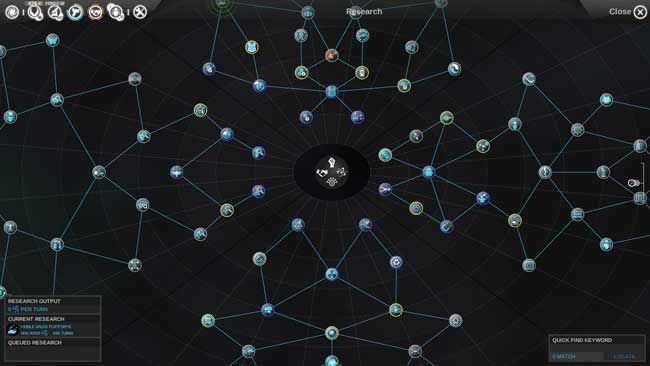
One place the interface couldn’t save is in how you handle research. You’re presented with four large trees that correspond to biology and expansion, the military, computers, etc. Unlike Master of Orion’s “tight vine” approach where you pick an option out of each node, you’re left to your own devices figuring out the best research path as you attack one node at a time (see: Master of Orion 2). Although the game does an excellent job enabling you to scope out a future technology and let it auto-queue all the research nodes in-between, saving you from micro-managing the effort, research is ultimately a failure because you simply have no idea what you’re researching or how it affects your empire. Piling on, many nodes have non-obvious names and descriptions that ameliorate their usefulness. Does this new armor really help me out? What are the practical technologies/gameplay elements that will emerge if I research this? What if I just want to research a specific tech, like ‘ray gun that will make ships blow up faster’, how do I even begin to understand how to acquire it? In its view, you’re granted every shred of knowledge you could possibly need and at the same time, you’re given so very little to base decisions on.
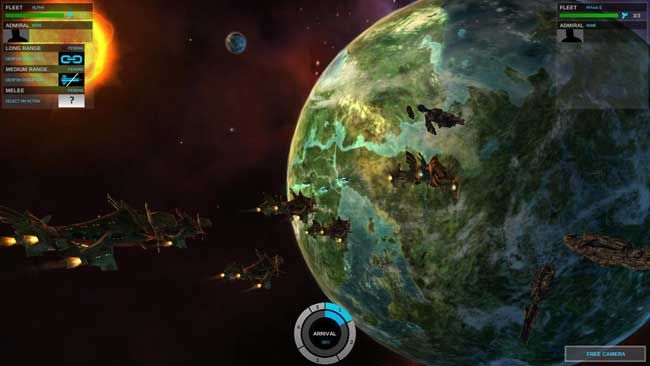
Space battles are hands-off affairs that, if played manually, look pretty cinematic, but are almost exactly the same from match to match.
I could never sink into the game’s space combat. Ships built can be arranged into fleets, which are (at least initially) a group of seven ships. This allows for bizarre encounters in which a super powerful force tackles the misfit group of one or two ships you keep parked in orbit, rather than the Super Battle Group you built for this situation. Battle itself is relatively hands-off. You’re given a “prologue” to plan out your long/medium/short-range attacks by picking one of a dozen “cards” to play, which encapsulate broad actions like Defense, Offense, Sabotage, and Retreat. These cards are loaded with stats, rather than genuine reasons to pick them, so I often found myself playing the Offensive overpower card and it worked pretty well. Whether you win or lose, it never feels like the result of a deliberate decision on your part, so I never learned much about my tactics or how to build a better fleet.
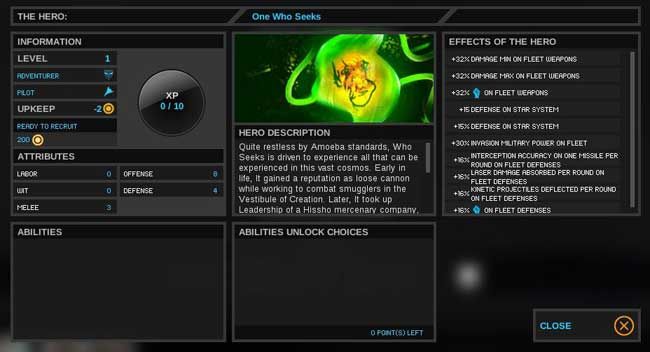
Use this screen to determine if a Hero is a good fit for your system or fleet. Also: good luck.
A recurring element is in how much the game wants to keep the gameplay simple, but chooses the most cluttered and ineffective manner to present data to you. In one way, galactic events that occur between turns are ingeniously arranged on the map in a line of interface bubbles, Bullfrog-style. In another, the game makes it difficult to understand why you should pick Option A over Option B when it matters most by granting you access to every stat possible over an executive summary (or perhaps, a simple reduction of factors). Heroes can be hired to empower your stars and fleets, but why do you pick one over another? The data simply becomes a hazy mush flipping between them. Why not hire every hero who becomes available? That seems so much easier. On top of this, you’re forced to micromanage uninteresting aspects of your empire which, again, seems antithetical considering how much Endless Space strives to keep things easy. The aforementioned heroes? They don’t merely level up, you can also assign perks, which are again broad elements of Offensive/Defensive/Manipulative traits that the game makes little effort to distinguish. Why should this hero get this perk? What kind of effects will I really see, aside from a +15% here and a +7 there? I don’t know.
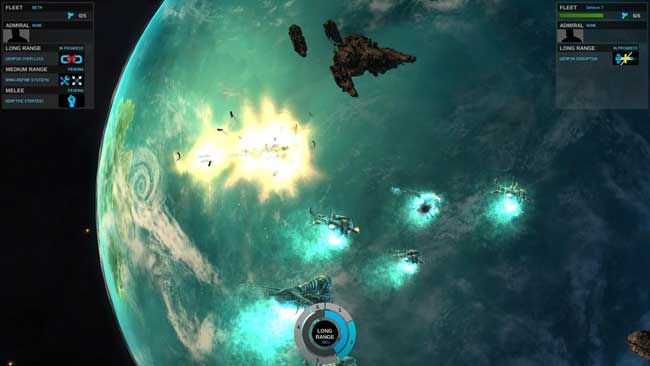
The combat pays off sometimes, like when you’re winning, and not losing, like I am in this shot.
Similarly ineffective (or really, just uninteresting) is the “trading window” diplomacy that never puts you face to face with other races. Though there’s plenty of cluttered data at your disposal, you’re largely left to your own devices to determine how worthy another empire is. It’s difficult to empathize with or emphatically despise a force that you can’t really begin to understand, leaving you to deal with other races as a number-cruncher, rather than as a benevolent ruler who can view a species’ art and learn how to attack them effectively. (Yes, I just made an Admiral Thrawn reference.)
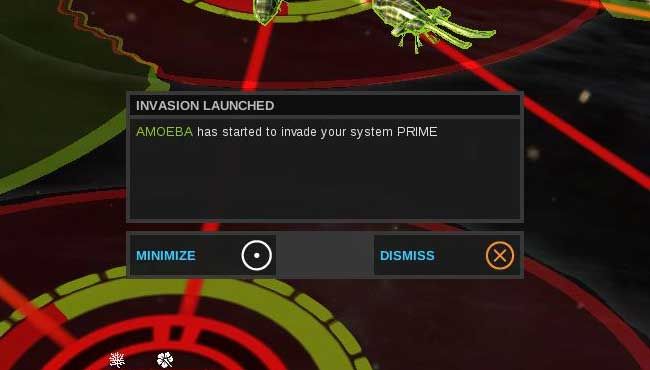
Fine, invade my stupid homeworld! I didn’t need it anyway!
No Throne For You
Endless Space’s biggest problem is that it simply never projects the excitement of bringing your chosen race out to the stars to form a massive imperial shroud over the known universe. At no point do you feel like the Grand Leader of a Galactic Empire, dining on Dishes of Grandeur. Amplitude Studios, like so many others before it, has built a core around the solid old ideas of Master of Orion, but it not only fails to capture the prestige of that game, but it can’t seem to strike out on its own merits without complicating things unnecessarily. At no point did Endless Space ever became fun to play. Yeah, you can see the growing web of your empire. Yeah, you can see the drifting hulks of destroyed ships from battles previous as you struggle to capture a key solar system. Yeah, you can see the abstractions of how your brilliant ship design finally met battle and ripped those amoeba dudes a new juice portal. But that’s just it: there’s far too much hands-off abstraction. It’s the terrible sin that brought down Master of Orion 3 and it brings down Endless Space here. If you can wade past the raw scores of data and min-maxing with a galactic setting, then don’t hesitate to pick up Endless Space, but those looking to emulate the romantic grandiosity of erecting an empire to span the stars, well, we’re just gonna need to keep searching.






Don't Keep This a
Secret, Share It