



Perhaps the most exciting Zune to launch in the first year.
Launch
Microsoft unveiled the fruit of their efforts on September 14th, 2006 to the media, launching the Zune 30 two months later for a competitive $249.99 paired with the Zune Pass subscription service for $14.99 a month. While others had subscription services through the PlaysForSure days, Microsoft’s marketing enticed new Zune owners to fill their entire player with music for the price of an album each month. There were hopes that as a dominant player, Microsoft could also push Apple to offer subscriptions through iTunes as well. While the Pass alone was good enough to get me on board (as opposed to purchasing music in $.99 increments) Zune was still behind the curve in multiple ways. The desktop software was buggy and incomplete. The marketplace didn’t have podcast support or a video marketplace option. (iTunes launched video rentals in late 2006. Lee would claim that the various/smaller screen sizes would be an issue for video.) Microsoft also had an issue in releasing another 30GB hard drive-based MP3 player into the market at a time when people were fishing for smaller, cheaper flash-based players from Apple or SanDisk.
Zune didn’t sell. Despite their best efforts to bind all of these disparate components into a new identity in a little over a year (even throwing out $500 million to promote it), they could never break double-digit market penetration against the iPod, ultimately selling 1.2 million Zunes in its first year. By comparison, Apple sold 22 million iPods during the 2006 holiday quarter. While never citing the bad news, Zune’s President Bryan Lee announced his retirement on February 1, 2007, less than three months after the Zune debuted; hardly good news for the fledgling player. Lee was replaced by J Allard full-time, who had a long road ahead of him to reach Zune’s potential. In interviews, Allard appreciated the Zune’s first year in that it allowed them to ‘fail fast’ and learn how to better handle their new brand.

J Allard (left) shows off second-generation Zunes with Bill Gates in 2007.
Taking Form
With the amount of improvements and additions that Microsoft made with the second generation of Zune hardware and software, Microsoft was caught in a Catch-22. Should they have made the Zune the right way by delaying it a year? No, they had to launch when they did, which was already too late, but would launching with a complete Zune experience sold more players? The first major upgrade came in the player hardware. The first was “Scorpio”, the second-generation hard drive player which shed the larger iridescent coating, with a larger 3.2″ screen and an 80GB capacity. The Zune 80 launched alongside new flash-based players, codenamed “Draco”, a late and much-needed arrival. Microsoft opted to take control of manufacturing from Toshiba, employing Singapore-based Flextronics (which built both Xboxes and had been a partner for Microsoft Hardware for many years) to build the new players. Second-generation Zunes introduced the Zune Pad, a squircle-shaped touch-plus-click pad that made navigation even faster.

The Zune 80, visually identical to the third-generation Zune 120.
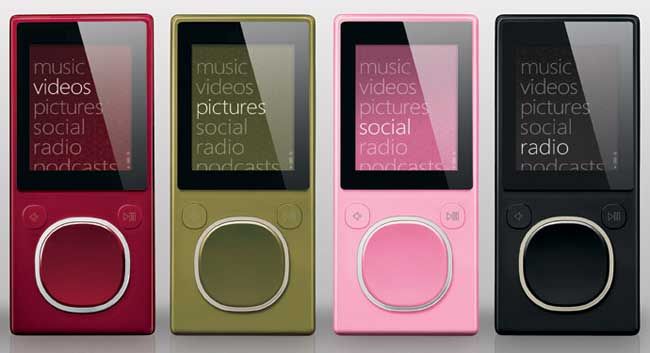
Draco arrives: The flash-based Zune 4/8/16s weren't enough to save Zune.
Microsoft updated the players to include larger Segoe-based text and enhanced the Zune’s branding with a rebuilt-from-scratch desktop client that was better equipped to handle expansions to the Zune service. With an FM tuner in each Zune, owners were now able to tag songs they heard over the radio, sync their player, and access those songs via the Marketplace. Microsoft also opened wireless synching for all players so owners also no longer had to plug their Zune into a computer to change its contents.

Zune's revamped desktop software, finally doing the service justice. Photo credit: Shadowsillusion.com
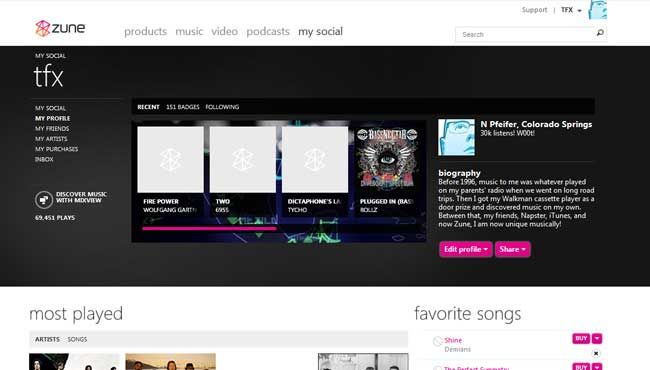
The web-based Zune Social implemented a lot of lessons from Xbox.
One of the biggest additions in the 2007 refresh was the Zune Social, a social network. Taking many cues from their work on the Xbox 360, the Zune Social tied into that same friends list and kept track of your favorite songs, albums, and artists, doling out “badges” for listening to music. It was very forward-thinking and in-depth, traits that Apple’s Ping service failed to emulate when that service released. After Amazon paved the way, Microsoft also embraced DRM-free music that could be downloaded and played in any device, offering a million DRM-free tracks far ahead of Apple. Microsoft would later would also offer ten free songs per month on top of their Zune Pass, allowing subscribers to keep many tracks they loved without being bound to the service.





Don't Keep This a
Secret, Share It