


Now What?
It was easy for me to distracted in the year that followed as I eventually got to work on that E3 documentary I’d always dreamt of. As the new year began, the company announced the first wave of layoffs at the same corporate offices I had been to regularly a year earlier. When I wasn’t shooting, editing, animating, or watching Infinite Lives, working at Best Buy had become the antithesis of the things I had fought so long and hard for. To combat operating costs, the company adopted the roster of smaller format stores by consolidating the staff of every store into two massive departments. Despite some assistance, employees like myself stumbled to become experts of half the products in the store and were pulled regularly to assist in still other departments. I felt my grip slipping as widespread stories of Best Buy’s declining customer service became moment-to-moment realities in my very own store. Work on the documentary kept me sane, but upon release, never came anywhere near profitable. In failure came one big learning experience right after the other.
One More Shot
My morale was all but gone by the beginning of 2010. Whatever high I felt being somewhat insightful to corporate employees was now long gone. Still operating at an entry-level position making less than $10 an hour, while new hires became progressively younger in relation to me, nothing felt right. Again, I weighed my options. A return to college was out of the question at that point. A lateral move to a call center would have netted me more dollars, but I wouldn’t be selling games. What the hell was I even doing?
In retrospect, it seems odd that I waited until 2009 to get my first smartphone. As soon as employees were allowed to purchase them, I snapped up a Palm Pre featuring the company’s sparkly new webOS operating system. I’d dreamt for so long of being able to take pictures at any moment and share them, mostly as artsy compositions. Whether it was TwitPic or Facebook, I uploaded most of the thousand-plus pictures I took with that phone before it failed. Of the ones I took at work, I did so with several precautions in mind. I didn’t want to violate the company’s social media policy, a lesson delivered by the plastic-haired man in those corporate videos more often as time passed. I also didn’t upload any pictures that couldn’t have also been taken by a customer, which ultimately served as my rule of thumb.
With the help of a new store manager and some of my contacts at corporate, I shaped a new plan. I’d still change how Best Buy did business, so my customer would have a better experience, but this time it was going to be through social media. Through the suggestion of a store-level associate, Best Buy had created a Twitter-based virtual blue shirt (slang for a Best Buy employee) who could help you out with the flash of a hashtag. It was called Twelpforce and the company spent millions of advertising dollars promoting it. It was a good first step, but it was far too impersonal. Specific employees were assigned to help out from the stores, but the execution, in my workplace and anecdotally in many others, was sloppy at best. Keeping with the theme of virtually interacting and knowing each customer, I was blessed with the opportunity to start a Facebook page and Twitter feed for our store to promote upcoming events while educating and communicating directly with our local customers.
Justification came quickly. Within a week, an irate customer came on to our Facebook page to complain about a bad experience he had in regards to his iPhone 4 purchase. The bleeding edge Apple phone was a white hot item and we’d pushed too many pre-orders, leaving said customer to wait a week or more to get his new phone. I went to my store manager who tracked the customer down and called him, apologizing for the kerfuffle and offering him a discount on accessories for the inconvenience. With these new tools, I had no intention of middle-manning any more bad experiences, but it was that virtual interaction between the store and the customer, even with the most fleeting connection to our internet pages, that I wanted to encourage over and over again. This was the personal future of retail with an expert ready to help at any time with actionable responses. In terms unspoken, I spent dozens of hours, on top of the hundreds I’d spent on The Escape Plan and other efforts, working off the clock as a still-hourly employee trying to make these connections happen. Like the company would pay any line-level associate to do what I wanted to do with the results I achieved, which were virtually none. Fresh off the documentary, I was more than happy to charge the company for the time it took to edit together in-store video projects, though.
In fact, it was right as I was about to meet with my manager to arrange some time off to work on a mini-documentary for the upcoming Halo: Reach launch event that lead to a most uncomfortable series of events.
September 1, 2010
The video is above is over forty-five minutes long, but had I seen it before the events of September 1st, 2010, things would have occurred very differently. I’d like to think I’m a pragmatic guy so it never made much sense to me that if left with the ability to help police during an investigation, even if you were somehow involved, it would behoove you to do so. This video changed my whole perspective, more specifically, it changed my whole perspective on private security. Whether you watch it now or after you read the events that transpired, this video made telling my story a very personal and pertinent matter after shrugging it off for so long.
The fact of the matter is that I am not an MBA or even a BA. I have no formal economic training or business management experience. Would any of my suggestions changed the world? Would Best Buy’s growth not abruptly stalled when my corporate trips ended – right before the global economic collapse and a management-lead nosedive that destroyed Circuit City? I don’t know, but so long as I had a fire in my belly, I wanted to change the world in ways that were practical and made sense. Things got complicated, though.
So I’m on the way to our store’s private meeting room, a long space lined with marked up white boards, hanging notes and when populated by the store’s leadership during their weekly meeting, becomes a hot, almost intolerable box. Inside were only two people: my manager on the far end and someone new facing the door. He stood as I entered, freshly shaven with a white shirt lined with blue pinstripes. He beamed with authority.
We’ll call him Kirk.
He advised me to close the door and remove my walkie-talkie’s earpiece so I wouldn’t be distracted by the goings-on in the store. Kirk introduced himself as a district manager and despite his geniality, nothing felt right. While we introduced ourselves, I went through everything over my ten years with the company that could have possibly put me in trouble with the Powers That Be. All that undocumented time? Everyone does it, would he have evidence? Did someone catch me accidentally swearing in front of a customer? Same thing. Had a customer complaint gone all the way up the chain? I didn’t know, but sitting there, explaining to Kirk everything that I’ve just explained to you, it didn’t seem like I was gaining any ground with him. Whenever I ran out of words or anecdotes to sell myself with, it would be his time to move. It only took about twenty minutes.
“Do you know why I’m here?” Kirk said.
“No.” I said.
“Well, what happens next will be a result of what happens in this conversation. Okay?”
“Okay.”
“Let’s suppose you did something that broke a company policy. Do you know what I’d be referring to?”
“No.”
“Okay, well, you’re aware of people who have spread proprietary, confidential information over the internet, right?”
“Yeah, in fact, I remember when those pre-release iPhone 4 numbers were leaked,” I said, distancing myself from the act, a clear violation of company policy. Further, I explained an instance in which I had worked with corporate asset protection when our district managers had forced customers to purchase expensive bundles during the Xbox 360 midnight launch, another clear violation of company policy. I was really trying to win Kirk over with the idea that I knew how our company’s confidential information policies worked based on what the company had taught and my own subscription to common sense.
“Sure, so, do you suppose you’ve ever done anything like that?” He said.
“No.”
He responded with a huff. “Well, let me help you out then. Let’s suppose you took some pictures and put them on the internet and they violated Best Buy’s social media policies. Is this becoming clearer now?”
Yeah, it was. He had a way in. I nodded and gave a half-apology on the spot, but I stuck to my guns, repeating my lines about my corporate training and how I’d never intended to harm the company. From the bottom of a pile he kept on the table, he pulled out a manila folder. As soon as he opened it, I knew this whole debacle would be a matter of convincing Kirk that I wasn’t a threat. He turned the first two sheets toward me. They were screenshots of TwitPic, one after the other, with the following pictures on it. (NOTE: These are, naturally, smaller than the original 3MP shots.)
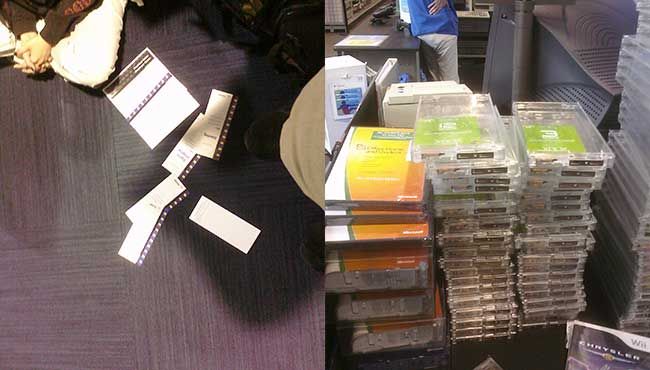
The picture on the left is the accumulated mess of a morning training. Corporate had shipped us a lot of unnecessary training pamphlets and they wound up as litter rather than reference. In the full resolution shot, the only legible words are “Gaming” and “Digital Imaging”. There’s also no proprietary or confidential information in view. I explained this to Kirk, who wasted no time, “anyone can take this picture and Photoshop any content they wanted onto these pamphlets, creating a potentially hazardous situation with a vendor.”
Huh?
He moved to the second photo. Because of theft concerns, store management had required that all customer-facing Point-Of-Sale Activation (POSA) cards be “impacted” or locked in magnetically-latched calcite cases, ones that you’ve seen at retailers everywhere. Despite the fact that the cards were useless if stolen because their serial numbers, just as the name suggests, had to be scanned at a register, we were forced to take a person off the floor when these needed to be restocked, eating up not only labor, but a valuable quantity of cases that could be used to protect far more valuable content. Kirk once again tried his ‘proprietary, confidential’ angle, but the activity could have been witnessed with a ninety-degree turn toward the registers from the store entrance. All of the action depicted happened in broad daylight.
He moved on, arranging more screenshots as if they were grim photos of a fresh murder. I couldn’t believe I was being held up for this.
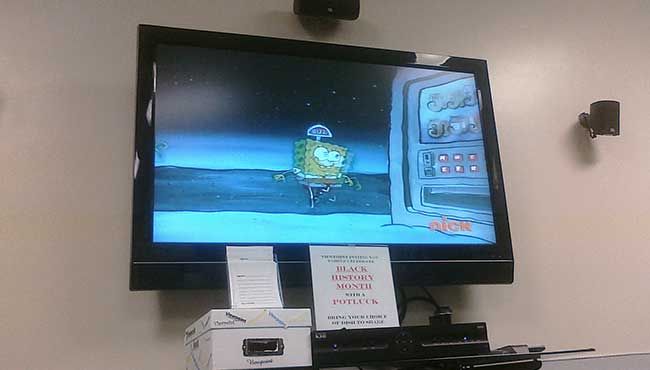
My snap of Spongebob Squarepants playing in our break room – my favorite episode, no less – and another of The Fifth Element during the “Leeloo Dallas Multipass” scene were “inappropriate”. Kirk had no further commentary.
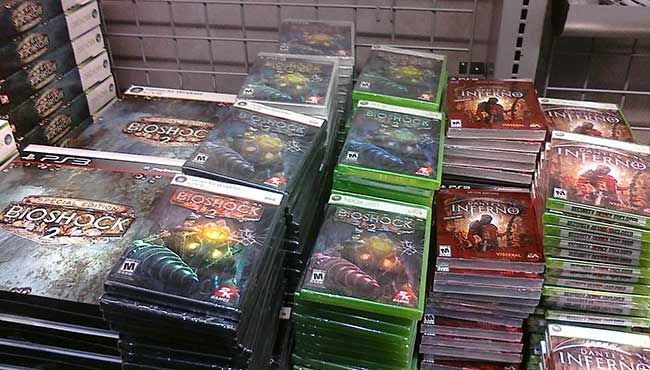
This photo seemed to be the crux of his offense. The evening before their release, I had taken this picture of an unquantifiable portion of our launch supplies of Bioshock 2 and Dante’s Inferno. In reality, all of these copies would be impacted and moved over to a customer-facing table at the edge of our gaming department; I had simply taken the shot twelve hours before a customer could have when the games would’ve been impacted and placed in their entirety for all to see. Kirk explained that, again, this could lead to a disastrous conversation with these vendors about quantities of each title in regards to our competition, in much the same way that employers don’t disclose how much they pay individual employees for fear of retribution. I didn’t explain it to Kirk, but my ulterior motive was to get people excited about the release of these games.
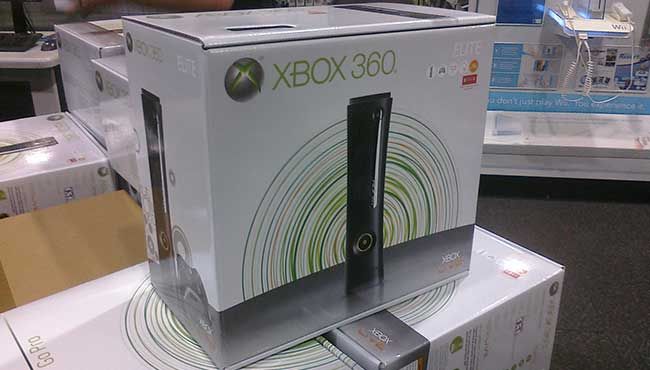
This one baffled me. When Microsoft refreshed their Xbox 360 packaging in 2009, the last time they’d do so before their slim models released, I took a picture of the consoles fresh out of their corrugate packaging. This was mere moments before the consoles would be securely fastened with “spider wraps” and placed on shelves about eight feet away. Kirk, again, believed this was a security issue. He was also curious about whether I had permission to take pictures of the customer in the background, who was actually an employee in uniform. If this was the best effort they had for whatever they were trying to do to me, shaking it off seemed like an easy task. I was no longer tense in my seat and whatever panic I sensed in my voice disappeared. Kirk said he “could go on”, but instead showed me one last photo.

Remember when I said earlier that I wanted a smartphone for the sake of taking spontaneous, artistic photos? Y’know, things that looked cool? A few months before this meeting, management had installed two fish-eye mirrors along the back wall of our gaming section where “shrink”, or theft, had become a severe issue. My motivation with this shot? I wanted a cool shot of a fish-eye mirror. That’s all. Kirk called it a potential security risk. With my assistance, I could help any potential thief case the place without ever visiting the store, this despite the fact that any customer had clear, unfettered access to both of these mirrors at any time. We had no store policy or precedent toward stopping any customer from taking pictures in our store. Why was the matter different because I took the photo?
At this point, I wanted this embarrassing meeting to be over so I could get onto planning our Halo: Reach documentary. This is the point in the article where it helps to have watched that video above. Since this was an internal Best Buy matter, I was offered no advice or opportunity for advice. I had unknowingly convicted myself and with Kirk’s next maneuver, he’d have it all. He pulled out another sheet of paper, this time with a field of measured black lines, beginning with a blurb I can’t remember.
“Well, we can make this work out. This is the point where you’ll give your apology and it’ll better help your chances.”
Chances of what? I wasn’t quite sure. Kirk and my manager left the room while I wrote, blow by blow, exactly what I’ve just explained to you, concluding each section with a statement similar to “I intended no harm to Best Buy.” If nothing else, I’m a solid, trustworthy, and honest individual and my superiors had nothing to fear from me except for my aggregating de-motivation to work for Best Buy at all. I knew something was off when the two returned and Kirk grunted when I requested a fourth piece of paper to finish my “apology”. I signed each paper and handed it to my manager, who jotted his signature as well. I didn’t look at either of them as the room sat silent, minus the scratching of pen strokes. Kirk broke the ice.
“I appreciate your honesty and cooperation in our discussion. Based on what we’ve talked about, you seem like a real upright guy and this goes a long way toward our investigation.”
My manager explained that I was now suspended. If the company found I was in the right, they would pay for my missed time. If they found otherwise, I would only be refunded any unpaid vacation, which I had scheduled to use in the following weeks as we had just signed a lease to rent a house. Perfect. We all shook hands and as I changed clothing to begin the two mile march home, I explained to my manager one last time that I had intended no harm to the company. I still didn’t feel like I was in the wrong, but I knew I had to clear the air and clear my name.
In retrospect, I have no doubt that Kirk left my store with a smile: I’d just hand-written my confession and handed it right to him with my sloppy signature confirming every single page of it.





Don't Keep This a
Secret, Share It