


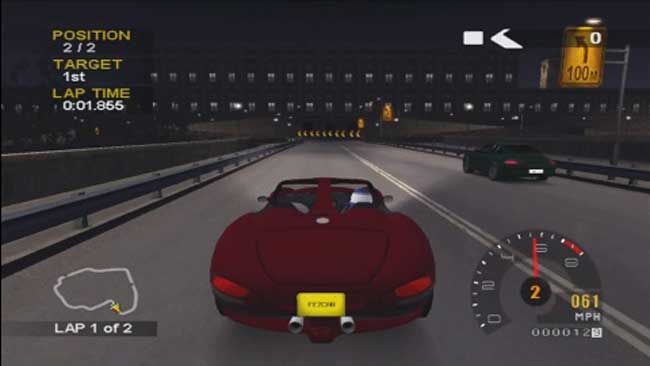
Project Gotham Racing 2 as seen by most people: with cars on streets.
PGR2 took full advantage of the Xbox’s hardware this time around, including improved physics and AI. The graphics were also greatly improved, but at a price: the game ran at half the frame rate of its predecessor, which eliminated the smooth look of the previous game. (Cakebread insists that given another two months, they could’ve gotten PGR2 to sixty frames per second.) The game also featured some of the first DLC for a console with the introduction of its Long Beach and Paris Booster Packs. Featuring new tracks and cars, the content was created by a small army of available artists at the end of PGR2’s development. “You don’t need thirty artists working on testing.” The content was going to originally be included on the disc, a tactic that made sense technically to Cakebread, but would force Bizarre to “risk the wrath of the gamers”. He’s unsure if the DLC was profitable for the company, but it would be one of many important firsts for Microsoft, who was very interested in this new market of post-release content. Even Bizarre had to recognize that it was now in the post-‘ship and move on’ era of game development, in which a game is ranked not only for its initial on-disc appeal, but in how well it was supported through expansions and downloadable content. Bizarre’s teams now had to take this extra workload into account for future games.
For his part, Cakebread worked on a variety of elements, including the loading screens, but he made two key contributions to PGR2. The first came in the game’s virtual garages. As you acquired cars in the game, they filled a virtual parking lot, the spaces becoming more and more impressive as the number of acquisitions rose. The camera switched to and moved around these cars as you selected them, but Cakebread was responsible for allowing the player to snap away from that fixed view and walk around the garage from the first-person perspective. As PGR2’s development wound down, the crew at Bizarre wanted to throw in a bunch of easter eggs – or clever hidden elements – and Cakebread’s second key contribution came to life: a little game called Geometry Wars.
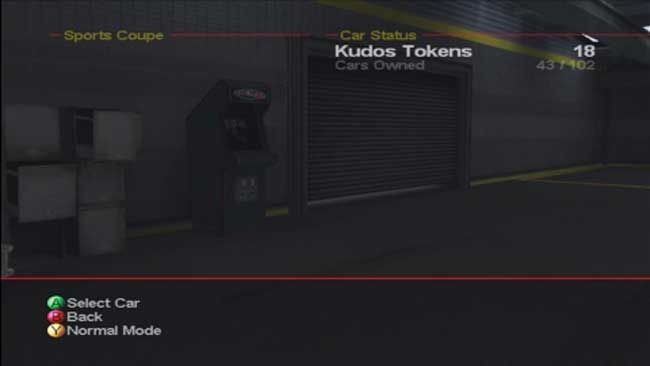
The Geometry Wars arcade cabinet sitting lonely in the corner, found by adventurous players.
Geometry Wars
While it originally took a button press, adding the walk-around garage inspired the team to erect a digital arcade cabinet in the corner of each of your garages. Cakebread had been working on Geometry Wars as a pet project at the time and, preferable to his taste, it was a brutally difficult experience. The game featured no lives or screen-clearing bombs. Players generally never lasted longer than sixty seconds per round. Cakebread wasn’t able to replicate this cruel, original version until he created the Waves mode in Geometry Wars 2. Geometry Wars also wasn’t originally designed for marathoning – in which a game plateaus in difficulty, allowing high scores to be reached through endurance, rather than skill – which Cakebread was opposed to. It’s probably for the best that he didn’t get his way, otherwise the early scoreboards would’ve looked more sad than triumphant. Like the hundreds of other events in PGR2, Geometry Wars’ scoreboards added an addictive key element, enabling you to compare your best runs with others on your friends list (remember: this was long before anyone used an Xbox to stream Netflix movies).
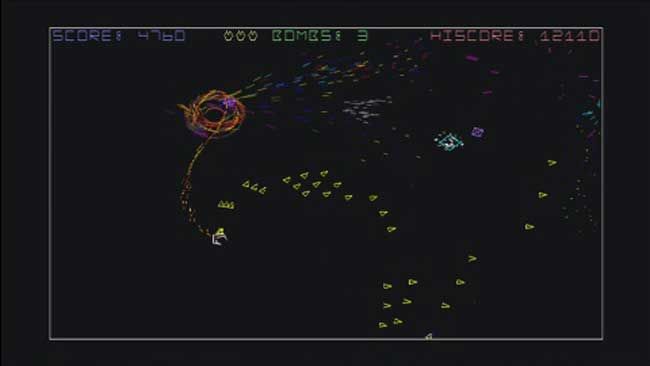
It doesn’t look like much, but this was a new beginning for Bizarre Creations.
The first enemies Cakebread implemented were grunts, blue squares that slowly chased the player’s ship. The purple split three enemies were inspired by Asteroids and, naturally, split into smaller foes when shot at. These smaller versions would begin to circle because, as Cakebread explains, it would be far too easy to wipe them all out in a dash if they weren’t slightly evasive. Geometry Wars originally featured a single static gravity well in the center of the arena that worked to clear the arena of enemies, modeled off one of the first video games, 1962’s Spacewar!. There, two players squared off around a star that could pull in the ill-equipped at a moment’s notice. In fact, gravity wells didn’t begin to move and interact with each other until later in development, when he says they looked cool. “Players would see these gravity wells swirling around each other and be ‘oh fuck!'” Green lattices called weavers ruthlessly dodged your ammunition, although an early bug allowed them to be easily dispatched with a specific spray downward and to the left as they simply weren’t programmed to evade in that direction.
This game-within-a-game not only became incredibly popular, but set Bizarre on a new tangent that would not only define them, but downloadable titles to this day.
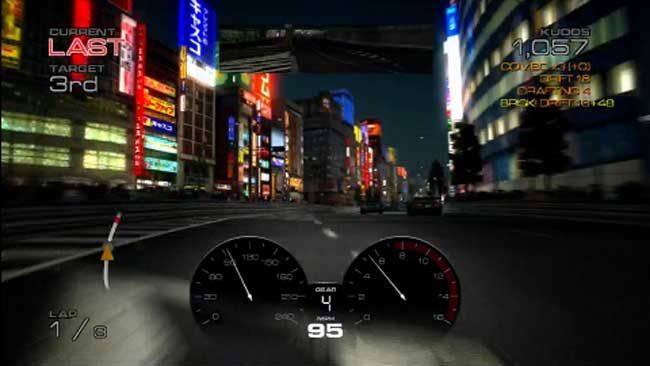
Project Gotham Racing 3’s Tokyo tracks would eventually inform Blur’s “night as day” design.
The Xbox 360, Project Gotham Racing 3
Word began to rumble in early 2005 that Microsoft was well on its way to unveil a new console. Console cycles traditionally ran for five years: you released the console at a loss, create some incredible franchises, create the sequels to those incredible franchises, and then just as you can get the hardware to a cost-reduced profit, you bring out the next one. At only four years in, it appeared that Microsoft was cutting and running mere months after the record-breaking release of Halo 2 and the first entry in their now-standard Forza racing series. Some gamers may not have been excited about investing in a whole new gaming experience at the time, but across the pond, Bizarre Creations sure was.
During PGR2’s development, Bizarre had begun work on Project Gotham Racing 3 for next-generation hardware and the technical wizards couldn’t have been more excited. “It was a brilliant move,” Cakebread says about Microsoft’s early transition. Like any new toy, the Xbox 360 was a new platform to figure out and so, just as before, the team started work on the new PGR title from scratch. PGR3 began life on the PC while Microsoft only had target specifications. The first development kits for the console were specially prepared Mac Pros as their PowerPC CPUs matched what Microsoft was including as the brains of their new console. Bizarre ultimately accrued a hundred of these Macs, storing them in a single that room that ran incredibly loud and hot. Cakebread says that as they graduated to final development kits, the Macs were reconfigured into a render farm to generate the massive world light maps for future titles. (They were ultimately replaced with beefier hardware and the room converted into an IT shack.) In one graphical aspect with PGR3 however, Bizarre would come up a bit short: the game’s sub-HD resolution. Microsoft had promised that with the Xbox 360’s onboard video RAM, it would be mandatory for developers to create games running in high definition (at least 1280 by 720 pixels) with 4x full screen anti-aliasing (which smooths out the image, removing ‘jaggies’ along high-contrast edges). Cakebread explains:
This is the curse of working on launch titles as you don’t know what the performance of the final hardware will be until a few months before the console ships. So instead you have to take an educated guess… we guessed slightly wide of the mark. So something had to give to ship the game on-time, and we compromised on reducing the back buffer size because it was the best looking out of all our available options.
PGR3 embraced many of the Xbox 360’s new features as a launch title, going so far as to develop what would have been a revolutionary new spectator mode called GothamTV… had anyone used it. “GothamTV probably took a year of someone’s time,” Cakebread says of the mode, which was intended to be the launch of a wave of eSports enthusiasm that only the Xbox 360 could provide at the time. Building largely on the ghosts concept of PGR2, in which you could download the best performance on a particular track and see how someone managed to cut that corner better or streak through those point gates faster, GothamTV allowed you to tune into other races by friends or from top players as they happened. The tech was so profound that Microsoft included it in the Xbox Live software development kit for anyone to use, but ultimately “people were more interested in playing the game than watching it.” Of no assistance was the fact that a revolutionary new video service named YouTube had launched that year, granting any average joe the ability to produce unique video content, complete with commentary and the advantage of a full editing suite.





Don't Keep This a
Secret, Share It