


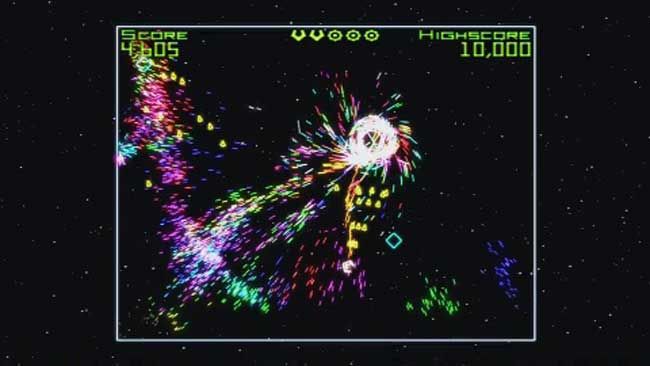
Project Gotham Racing 2’s Geometry Wars, as re-imagined in Retro Evolved, was included for business purposes.
Geometry Wars: Retro Evolved
But PGR3 wouldn’t be Bizarre’s only headline for the console’s launch: Geometry Wars as a standalone Xbox Live Arcade made perfect sense. “Geometry Wars was entirely 2D, we wanted [Retro Evolved] to look next gen.” For this round, Bizarre gave Cakebread a producer in Craig Howard, who served as a middle man between him and publisher Microsoft, leaving Cakebread more time, attention, and manpower to work on his game. Retro Evolved, named for its inclusion of a remastered version of the original Geometry Wars from PGR2 as well and a new version designed specifically for the Xbox 360’s new, high fidelity, high definition experience, became an early hit on Microsoft’s PartnerNet (a private network for Xbox developers) in the months leading up to the console’s launch.
Early in our interview, Stephen explained that the Retro mode of Retro Evolved, and the Evolved mode of Geometry Wars 2, were some of his biggest regrets in the two standalone Geometry Wars titles. In the case of Retro Evolved, the mode felt unnecessary and outdated. “Why would anyone play it, aside from nostalgia?” Ultimately, it was included as a business incentive. Bizarre had fit Geometry Wars into PGR2, but included the Retro mode as a mea culpa to new PGR3 owners who had just spent $49.99 on their title on top of $299-$399 for the new console. Fitting under Xbox Live Arcade’s 50MB size limit, Geometry Wars’ competition consisted mostly retro game ports and PopCap titles. Just as Microsoft had partnered with Bizarre to chase their DLC aspirations with PGR2, they hired them (read: Cakebread) to bring flavor to their new Xbox Live Arcade dream with a new Geometry Wars title. Given the choice, Bizarre once admitted it would’ve given Retro Evolved away for free, but Microsoft wanted premium content that not only inspired people to purchase Microsoft Points and invest in the console’s new marketplace, but developers of all sizes looking for a new venue to produce content that didn’t require a million dollar investment or discs on shelves. Retro Evolved still sells for 400 Points to this day ($5) and both PGR3 and XBLA versions include a four minute trial of the game’s Evolved mode. “Many people couldn’t complete it.”
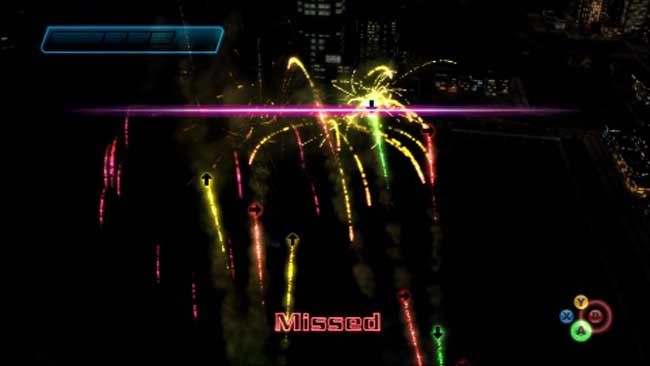
The fireworks-themed Boom Boom Rocket riffed on Dance Dance Revolution, but didn’t inspire many sales.
Boom Boom Rocket, Project Gotham Racing 4
On the heels of Retro Evolved’s success (the game would remain Xbox Live Arcade’s top seller for years after launch), Electronic Arts contacted Bizarre to build a rhythm action game in the same vein as Konami’s famous Dance Dance Revolution franchise and the up and coming Guitar Hero titles, focused on “fireworks in a city”. Bizarre had the tech expertise and knew they could produce it for cheap, drafting an experimental team to test these new downloadable game waters. Notables included game designer Jeff Lewis and, appropriately, audio engineer Nick Bygraves, who would later introduce the dynamic time-warping sounds of Geometry Wars 2. Cakebread was also initially on-board to handle some of game’s tech, but was pulled off to other projects. The game featured riffs on tracks in the public domain by composer Chris Chudley, brother of Bizarre co-founder Martyn Chudley, who also produced the music for all of the Geometry Wars titles. On release, Boom Boom Rocket was not the success Bizarre or EA hoped for. (A later update added both dance pad and guitar controller support.)
As the owners of the Project Gotham Racing franchise, Microsoft kept Bizarre on retainer to produce the games on a biennial basis when in reality, they could’ve picked any developer to fill their shoes. It’s no surprise that with Bizarre’s incredible record, the series hasn’t been refilled since the release of Project Gotham Racing 4 in November 2007. One curious dynamic I’d asked Cakebread about was their relationship with Forza maker Turn 10, who had been created in-house at Microsoft to tackle Sony’s popular PlayStation racing sim Gran Turismo. Posting to web forums in the mid-aughts, it seemed as though Turn 10 was becoming Microsoft’s golden child as Project Gotham Racing, and ultimately Bizarre itself, were boxed up and stored away. But Cakebread says there was no animosity between them and there was no “second fiddle” feeling at Bizarre in regards to Turn 10. “Several employees from Project Gotham went on to Turn 10 and we had a working relationship with them. We swapped tech with [Turn 10].” Project Gotham Racing and Forza, he feels, ultimately served different audiences. Years later, the team behind the upcoming festival-themed, Colorado-based Forza Horizon, although unsurprising after a quick preview, is made up of many former Bizarre employees.
Bizarre had also dreamt of a PGR5, which they knew would have to be a complete shakeup. “[The series] needed a good gutting” Cakebread says, but PGR4 would be their last chance to make a difference.
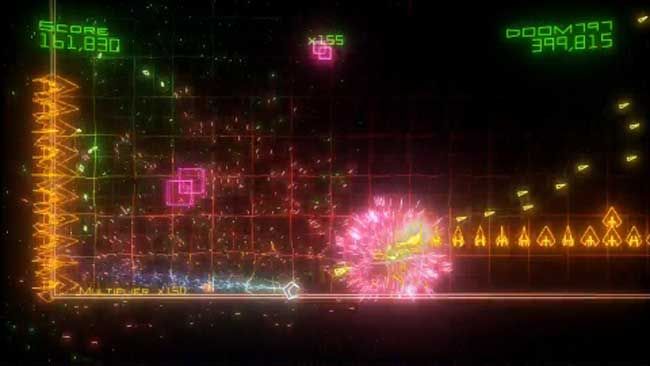
The brutal Waves mode of Geometry Wars: Retro Evolved 2. “The audio track only lasts two minutes. If you’re alive that long, it’s not something you’re paying attention to!”
Geometry Wars: Retro Evolved 2
Although the follow-up to Retro Evolved didn’t arrive until two and a half years later, Bizarre’s development director asked Cakebread to begin work just three months after its debut. And he obliged, for a time. Building the game in full 3D and featuring psychedelic Minter-esque visuals, Cakebread only managed to work on the project for a month before setting it on the backburner. “I couldn’t do it right away. I didn’t want to make a shitty sequel.”
When work began in earnest in 2007, Craig Howard returned once again to produce, providing him specialists to make the title a technical marvel. The game employed three people for audio alone, although Cakebread emphasizes that they only worked on the game for about a week each. Just like his prototype, Geometry Wars 2 was presented in full 3D (as in, every object was rendered with polygons, instead of being drawn on a flat surface like previous versions), which allowed for some amazing gameplay trailers. (A secret fly-around mode was left in the game accidentally for its release. “I have no idea why people thought it was so difficult to use!”) While he’d wanted to restrict the number of modes in Retro Evolved (ideally, to just one), he wanted to open it up for the sequel and explore what a twin-stick shooter could do. He also wanted players back in the action quickly during (the inevitably many) failed runs. “”I just wanted to get back in. I don’t want to animate menus, you should be able to hammer the button.” In an early iteration, the game also featured a Pong variant with a gravity well on either side. When a gravity well exploded, it would naturally release its homing projectiles to knock out the losing opponent, but if they were crafty enough to dodge them, they could knock out the winner in a cruel twist.
Pacifism was the first mode implemented and as a result, stands as probably the most prolific. Here, you’re spared the conventional firepower and are forced to run from opponents. Crossing through barbell-shaped obstacles on the map detonates them, forcing the swarm away, albeit temporarily. Pacifism was originally an achievement in Retro Evolved, requiring you to make it through the first sixty seconds of a naturally spawning Evolved match without firing a shot; a challenging task. Early versions also featured rocket foes that would line up and charge at your ship, but they were ultimately removed and used in other game types.
Pacifism also featured a pair of its own harsh achievements: Wax On and Wax Off, which were originally intended for the game’s Deadline mode. There, you guarded corners, but matches quickly devolved into stationary turret shooting sessions. The final versions required required players to brush the entire edge of the arena. Wax On could be easily accomplished before enough foes had spawned to cause trouble for your defenseless vessel, but a second brushing in Wax Off required players to “actually play the game as intended” in order to be successful.
Sequence is a linear series of small, specific matches that were originally designed to demonstrate the multitude of new enemies that Cakebread had created, “but the whole thing felt like a kitchen sink” and he ultimately removed many of them.
Waves, which was included as a standalone mode in PGR4, is the closest to Cakebread’s original, intensely difficult version of Geometry Wars. In it, lines of orange foes spawn at a time and sweep across the arena in perpendicular directions. Naturally, failure comes quick.
Evolved is the mode of Geometry Wars 2 that Cakebread felt “didn’t come across well on its own” and was dithered by at least two of the other modes, including Waves. Like the Retro mode of the previous title, Evolved is the preserved form of its predecessor, more of a ‘tip of the hat’ than a stellar experience on its own.
Geometry Wars 2 became another successful take for Bizarre and had Microsoft not negotiated for exclusivity, the game would’ve also landed on the PlayStation 3 at Cakebread’s insistence (“everything was working except the sound”).





Don't Keep This a
Secret, Share It