


For now, yes.
The Activision Acquisition
Despite Bizarre’s successes, the two hundred-strong developer never got a proper break. Games were getting expensive and Bizarre only kept enough money in pocket to produce prototypes to pitch to publishers in hopes they’d be picked up for full multi-million dollar projects. Despite becoming a champion of Xbox Live Arcade, the thought never occurred to them to start working on smaller projects for downloadable services as the company didn’t view these as legitimate revenue streams. “Why don’t we have three teams working on Xbox Live Arcade games? I really admire what Double Fine was able to do [in regards to self-publishing].” Had Bizarre lasted a few years longer independently, he contends that even Kickstarter would’ve been a valid funding option. Instead, Bizarre was only interested in producing big blockbuster titles and the only way this could be sustained, they believed, was through an acquisition. The offers came, but most were awful and with talks being several pay grades above him, Cakebread could only speculate on the terms. The company eventually settled on Activision, who allowed the company to exist on its own terms – for a while, anyway.
Cakebread says that the culture didn’t begin to shift for another six to twelve months after acquisition, when the company began to feel less nimble than ever. After the success of Geometry Wars 2, he was excited to work on an entirely new project, but recruiting the two or three people he needed was difficult with the new extra layer of management above him. Bizarre also had a strong relationship with Microsoft, which provided a learning curve in the transition to Activision. “Microsoft knows how to make software, schedule it. Bizarre knew what to expect from them.”
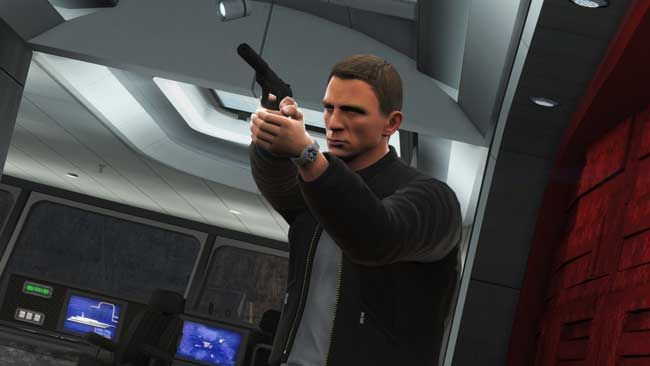
James Bond excited Bizarre, who wasn’t really equipped to build a James Bond game.
Blood Stone
Despite being a license title, Bizarre was passionate about building a “cool, British” game in Blood Stone, a James Bond action game with an original story and characters, but the game played on the company’s flaws. “Shooting was a little outside our comfort zone.” Work on Blood Stone began right after the release of The Club in early 2008, itself a point-based shooter in which you racked up combos by killing creatively, not unlike their treatment of racing games with Project Gotham Racing years earlier. The game wasn’t a success, but its influence can be seen in other titles. Creating Blood Stone was a drug out process that lasted nearly three years, primarily because of Bizarre’s insistence at drafting their own tools. Following the acquisition, Bizarre had been reorganized into three new teams: two-hundred person teams, working on Blood Stone and Blur, while Cakebread worked in a third thirty-strong technical team that unified the company’s various engines and aspirations. For The Club and Blood Stone, the company had strongly considered licensing an engine like Unreal as many of their designers had experience with those popular tools. In retrospect, Cakebread says licensing would’ve given them a six month head start, but they ultimately laughed off the suggestion. Not out of pride, but rather the notion inside Bizarre that they could (and would) always create their own tools.
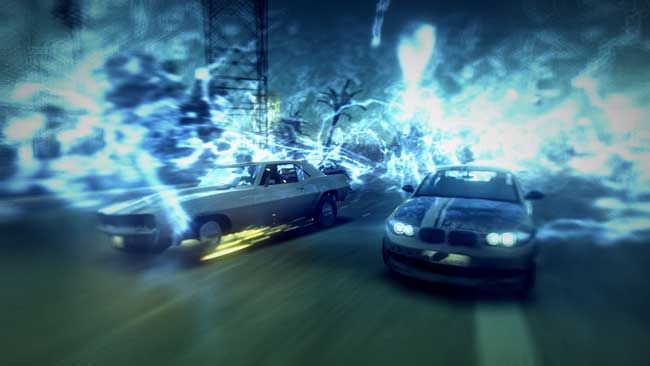
“We wanted to make Mario Kart for adults.”
Blur
If Blood Stone was built on Bizarre’s weak skills, then Blur was built on their strongest. Following the restructure and merger of Sony’s Liverpool developers into Evolution Studios (makers of Motorstorm), Bizarre acquired a lot of talent. The result was Blur, a car-combat racer and obvious child of its parents: Project Gotham Racing and Wipeout. Activision wanted a strong racing franchise to compete with Electronic Arts’ Need for Speed, but wasn’t interested in another PGR-style game. Instead, Cakebread says, “we wanted to do Mario Kart for adults.” A friend of his had “every console” and they spent a lot of time playing car-combat titles. Many gathered in the Bizarre offices with their DSes and played Mario Kart in savage 16-player matches, which Cakebread says he “became devilishly good at”.
Much like PGR a decade previous, Bizarre had an extremely difficult time with the title. Activision employed two different brand agencies, taking a year to arrive at ‘Blur’. The ‘night as day’ setting of the game (similar to how World of Warcraft keeps night scenes bright to maintain playability) was designed to show off the many special effects and neon lights they were including. Weapons originally had a Quick Time Event-style operation (Cakebread explained pressing buttons as a projectile was on its way to your vehicle) before the game was rebooted late in development and made more interesting. Unlike its spiritual forebear, the combat system of Blur was more strategic. Power-ups littered the course, but could be collected to augment their abilities. Short cuts and other slices of track were designed specifically so that knowing players could change course to acquire certain defensive or offensive abilities depending on their situation. Much like Mario Kart, “it wasn’t fun to be hit in Blur,” especially as the game’s physics – admittedly much more complex than Mario Kart’s – sent players into very random directions on impact. Cakebread worked to make impacts more predictable, so crashes, despite being an inconvenience, kept players on course and made the game more about trading blows than completely debilitating your opponents.
The Last Geometry Wars
Before the acquisition, Bizarre worked to move Geometry Wars to other platforms. While the PS3 version had fallen through, getting the game on any device with a pair of joysticks was part of Cakebread’s vision for the series. He was responsible for moving the core of the game to these new platforms (he says he moved Geometry Wars to iPhone in a day, thanks to its native code support), but he didn’t fall in love with these new versions as “they didn’t feel quite right”. The series move to iPhone, the Nintendo DS, and the Wii were handled by external developers, while Cakebread contends that Geometry Wars would’ve been available at the launch of the Apple App Store in early 2008 had management not been a hindrance. Cakebread says that touch screens haven’t quite won him over and despite the growing share of mobile phones against dedicated handhelds in the portable gaming space, a gaming device with physical buttons will still be necessary.





Don't Keep This a
Secret, Share It